" width="124.99999816468596px"><path d="M 54.181 6.847 L 47.466 6.847 L 47.466 2.585 C 47.466 2.235 47.608 1.9 47.86 1.657 L 49.06 0.496 C 49.301 0.263 49.623 0.133 49.958 0.133 L 58.443 0.133 C 58.793 0.133 59.128 0.275 59.371 0.526 L 60.532 1.727 C 60.765 1.967 60.895 2.289 60.895 2.624 L 60.895 11.11 C 60.895 11.459 60.753 11.794 60.502 12.038 L 59.301 13.199 C 59.06 13.431 58.739 13.562 58.404 13.562 L 54.181 13.562 Z M 49.016 12.012 L 42.301 12.012 L 42.301 16.235 C 42.301 16.57 42.432 16.892 42.664 17.133 L 43.825 18.333 C 44.069 18.584 44.403 18.726 44.753 18.726 L 49.016 18.726 Z M 3.126 0 L 0 0 L 0 1.966 C 0 2.122 0.061 2.272 0.169 2.384 L 0.71 2.943 C 0.823 3.06 0.979 3.126 1.142 3.126 L 3.126 3.126 Z" fill="rgb(0, 0, 0)" height="18.726460794826536px" id="Z5fIrvb9u" transform="translate(64.105 0)" width="60.8950024371469px"/><path d="M 67.271 0 L 64.144 0 L 64.144 1.966 C 64.144 2.122 64.205 2.272 64.313 2.384 L 64.854 2.943 C 64.967 3.06 65.123 3.126 65.286 3.126 L 67.271 3.126 Z M 84.707 18.726 L 84.707 0.133 L 87.841 0.133 L 87.841 7.411 C 88.558 5.87 90.019 5.127 91.799 5.127 C 93.526 5.127 94.668 5.525 95.597 6.534 C 96.607 7.623 96.686 9.058 96.686 10.705 L 96.686 18.726 L 93.499 18.726 L 93.499 10.864 C 93.499 9.642 93.446 8.898 92.782 8.261 C 92.171 7.65 91.533 7.597 90.763 7.597 C 89.621 7.597 87.868 8.181 87.868 11.342 L 87.868 18.726 Z M 76.018 19.045 C 72.911 19.045 70.228 17.69 70.122 14.503 L 73.07 14.158 C 73.096 15.884 74.292 16.787 76.045 16.787 C 77.825 16.787 78.754 16.15 78.754 15.034 C 78.754 13.866 77.107 13.653 75.115 13.148 C 72.751 12.537 70.494 11.794 70.494 9.111 C 70.494 6.269 73.07 5.127 75.726 5.127 C 78.622 5.127 81.092 6.189 81.384 9.35 L 78.489 9.828 C 78.409 8.181 77.4 7.384 75.726 7.384 C 74.557 7.384 73.468 7.836 73.468 8.872 C 73.468 9.908 74.69 10.227 76.39 10.598 C 78.887 11.156 81.729 11.714 81.729 14.848 C 81.729 18.062 78.94 19.045 76.018 19.045 Z M 56.327 18.726 L 56.327 7.969 L 54.414 7.969 L 54.414 5.445 L 56.327 5.445 L 56.327 3.586 C 56.327 1.009 57.735 0 60.444 0 C 61.081 0 61.825 0.08 62.117 0.159 L 62.064 2.709 C 61.639 2.63 61.081 2.577 60.789 2.577 C 59.886 2.577 59.461 2.736 59.461 3.612 L 59.461 5.445 L 62.171 5.445 L 62.171 7.969 L 59.461 7.969 L 59.461 18.726 Z M 64.11 18.726 L 64.11 5.445 L 67.27 5.445 L 67.27 18.726 Z M 46.183 19.045 C 44.111 19.045 42.517 18.381 41.375 17.212 C 40.153 15.964 39.595 14.211 39.595 12.059 C 39.595 10.014 40.18 8.261 41.375 6.986 C 42.544 5.764 44.137 5.127 46.156 5.127 C 48.255 5.127 50.034 5.923 51.15 7.331 C 52.212 8.659 52.744 10.678 52.664 12.962 L 42.783 12.962 C 42.836 15.433 43.951 16.681 46.156 16.681 C 48.095 16.681 49.105 15.858 49.397 14.237 L 52.451 14.476 C 51.761 17.531 49.583 19.045 46.183 19.045 Z M 42.809 10.598 L 49.45 10.598 C 49.397 9.855 49.158 9.084 48.706 8.527 C 48.122 7.809 47.325 7.491 46.156 7.491 C 44.908 7.491 44.005 7.916 43.473 8.659 C 43.048 9.244 42.862 9.961 42.809 10.598 Z M 29.597 19.045 C 27.897 19.045 26.728 18.594 25.772 17.584 C 24.736 16.495 24.63 14.848 24.63 13.228 L 24.63 5.445 L 27.844 5.445 L 27.844 13.069 C 27.844 14.29 27.87 15.22 28.508 15.884 C 29.145 16.522 29.836 16.575 30.606 16.575 C 31.855 16.575 33.475 15.937 33.475 12.776 L 33.475 5.445 L 36.583 5.445 L 36.583 18.726 L 33.502 18.726 L 33.502 16.787 C 32.785 18.248 31.43 19.045 29.597 19.045 Z M 17.85 18.726 L 17.85 0.133 L 21.011 0.133 L 21.011 18.726 L 17.85 18.726 Z M 0 18.726 L 0 0.133 L 6.773 0.133 C 10.227 0.133 14.052 0.664 14.052 5.18 C 14.052 7.092 13.069 8.447 11.555 9.191 C 13.6 9.934 14.769 11.289 14.769 13.573 C 14.769 18.222 10.97 18.726 7.066 18.726 Z M 3.32 16.07 L 6.959 16.07 C 9.536 16.07 11.528 15.99 11.528 13.414 C 11.528 10.625 9.111 10.572 7.092 10.572 L 3.32 10.572 Z M 3.32 7.916 L 6.561 7.916 C 8.792 7.916 10.811 7.862 10.811 5.366 C 10.811 2.895 8.792 2.816 6.588 2.816 L 3.32 2.816 Z" fill="rgb(0, 0, 0)" height="19.04499996813226px" id="hc3K9vveG" width="96.68634569718273px"/></g></svg>)
30% of AI Inaccuracies are Caused by Inaccurate Sources, not just “Hallucinations”
Most brands assume AI inaccuracies are all hallucinations, but our latest findings found that is only part of the story.

Bluefish Research
Share
When enterprise brands voice concerns about AI inaccuracies, the assumption tends to be that AI is simply hallucinating responses to prompts it does not know the answers to. However, recent data from Bluefish Research suggests AI hallucinations are only part of the story. In nearly a third of cases, AI didn't invent the wrong answer, it actually read the inaccuracy somewhere in its training or RAG data.
Bluefish used its new AI Accuracy technology to track millions of brand claims — verified product details, finance rates, medical dosages— to measure how accurately they appeared in AI responses. Across inaccurate claims found with an associated verified source, our research showed that errors fell into one of three buckets:
30% of inaccurate responses can be traced directly to a cited source carrying an incorrect claim. Essentially, AI found wrong information somewhere on the internet and repeated it. This bucket is the most straightforward for brands to fix — identify where the error is being seeded and address it at the source.
Another 32% of inaccuracies tied to citations that didn't directly address the inaccurate claim. The model simply filled in the gaps where its cited sources didn’t address topics directly. For brands, this bucket can be mitigated with authoritative content strategies.
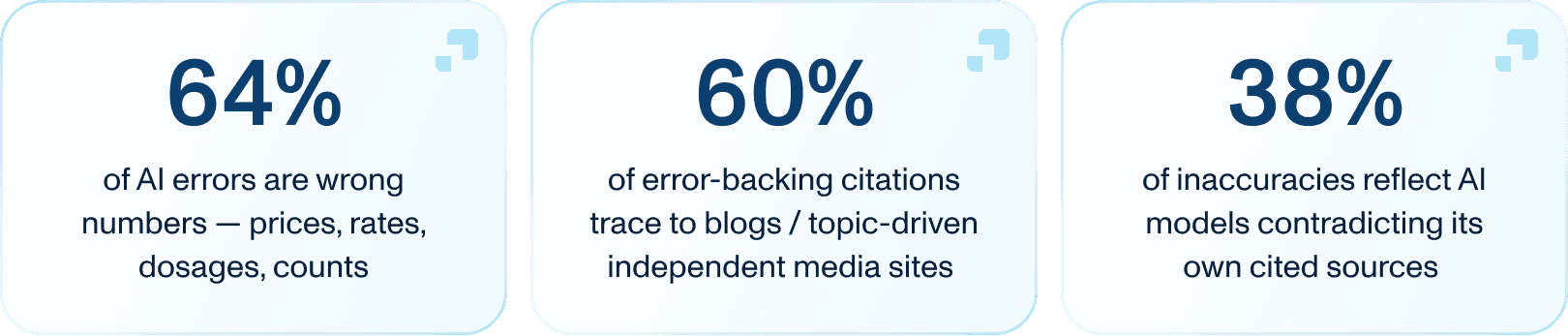
Egregiously, the last 38% of inaccuracies were claims made by AI that directly contradicted one or more of its own cited sources. Meaning the right information exists, but AI ignored it.
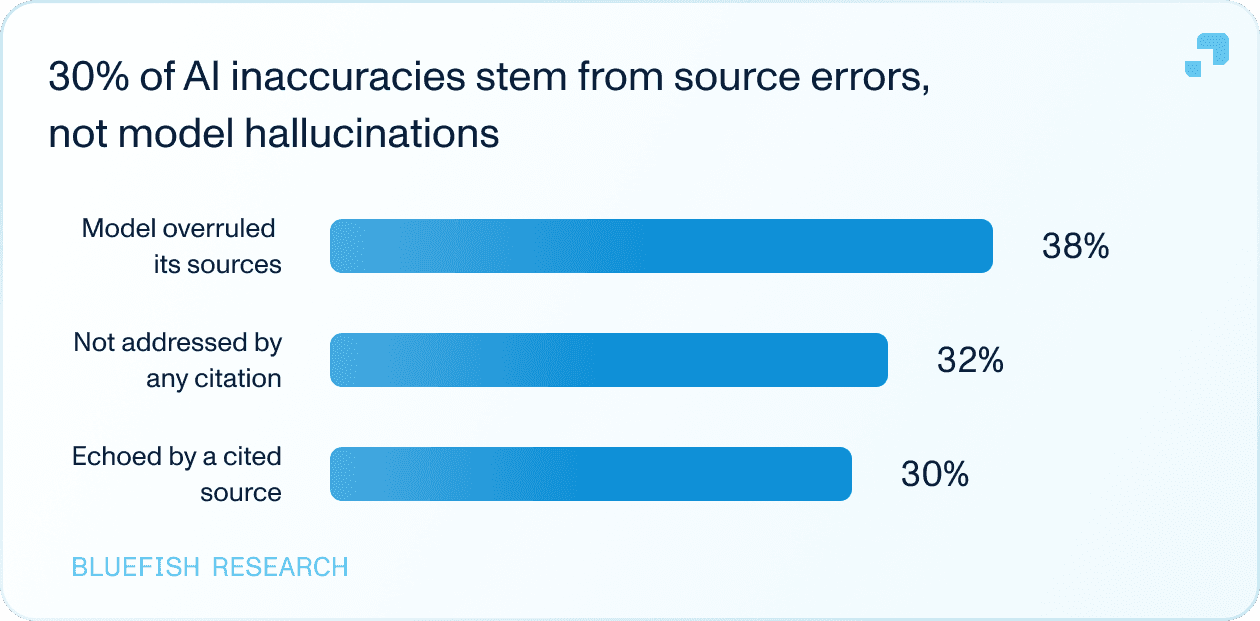
Brands that can see which bucket their errors fall into can prioritize action accordingly. For inaccurate AI claims that have a traceable origin, they are diagnosable and fixable. For more ambiguous claims, they actually light up a clear path to content gaps to be filled. And when AI contradicts a source that already had the right answer, that's an authority problem — the brand's messaging exists, but AI didn’t trust it enough to base an answer on it. With transparency, all three buckets of inaccuracies have a path forward, whether it’s earning presence, building authority, or driving repetition with PR and other partners.
A lot of AI Inaccuracies Involve Numbers
Bluefish Research also found that across major commercial brands and AI channels, many AI errors included incorrect numbers — prices, rates, counts, dosages — accounting for 64% of inaccuracies. In particular, Finance and Pharma have the highest-stakes outliers: In Finance, errors spread across rates, prices/fees, loan terms, and credit-score minimums. In Pharma, 21% of its inaccuracies reflected incorrect efficacy percentages and 27% reflected incorrect dosage recommendations.
The Internet (3rd Parties) is Getting Your Brand Wrong
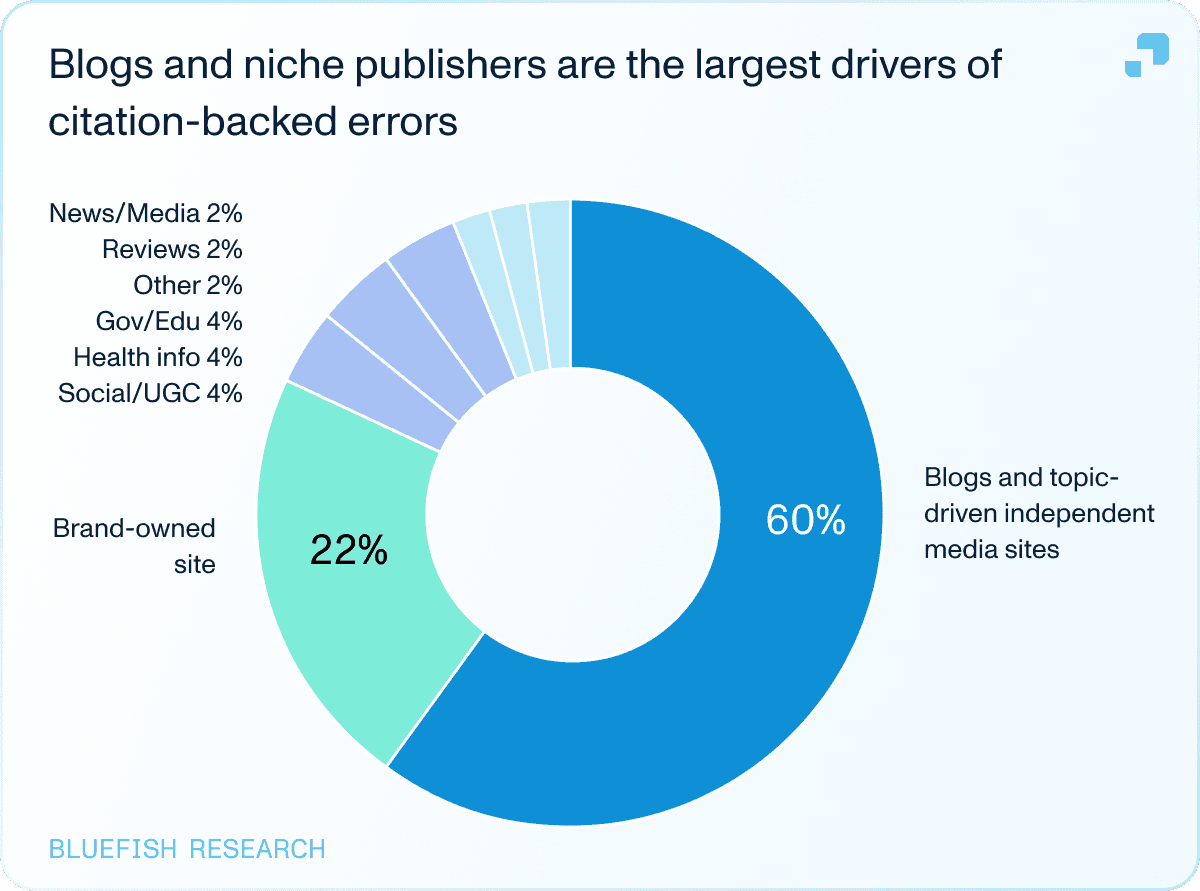
Unsurprisingly, when looking at traceable inaccuracies, 60% of citations propagating incorrect information tracked back to blogs/topic-driven independent media sites, while brand-owned sites only account for about 20% of citation-backed errors. Examples include personal finance bloggers citing a credit card APR, travel points sites quoting a baggage fee, or wellness blogs sharing dosage information. These third-party sites carry significant weight in AI responses, often much more than the brand's own page on the same topic.
Implications for Brands
The findings below reframe what AI accuracy means for enterprise brands. Brands are increasingly investing in AI visibility, topic authority, and source optimization to improve how they appear in AI responses. That investment is well-placed, but it builds on a flawed foundation if the way you show up to consumers is fabricated or misleading.
Optimizing for AI without fixing accuracy is like running a paid campaign to a broken landing page — you're driving traffic to the wrong answer. And unfortunately, high consumer confidence in AI coupled with condensed consumer journeys mean brands won’t have another opportunity to remedy their brand image before a purchase decision is made.
As brands build more robust AI Marketing practices, it’s important to note that Accuracy is not a one-time audit. AI responses change as models update, sources shift, and brand information evolves. A price that was correct last quarter may be wrong today. A dosage that appeared accurately in one model may be misrepresented in another. Brands that treat accuracy as a continuous signal will build the most durable AI performance over time.
AI Accuracy is Specific, Diagnosable, and Necessarily Addressable
Inaccuracy in AI is a specific, diagnosable, and in many cases addressable problem. Brands that understand where errors originate — which sources feed them, whether the model is echoing bad data or ignoring good data — will drive maximum actionability and ROI in their AI Marketing practice. Accuracy evaluation and error transparency help brands clearly prioritize organic and paid media investments, transforming Answer Engine Optimization into a growth driver for their business.
Bluefish's AI Accuracy Platform provides brands with claim-level accuracy data, citation root-cause analysis, and channel-by-channel breakdowns across Amazon/Alexa, Google AI Mode, ChatGPT, Claude, Perplexity, and more. Reach out here to learn more.