" width="124.99999816468596px"><path d="M 54.181 6.847 L 47.466 6.847 L 47.466 2.585 C 47.466 2.235 47.608 1.9 47.86 1.657 L 49.06 0.496 C 49.301 0.263 49.623 0.133 49.958 0.133 L 58.443 0.133 C 58.793 0.133 59.128 0.275 59.371 0.526 L 60.532 1.727 C 60.765 1.967 60.895 2.289 60.895 2.624 L 60.895 11.11 C 60.895 11.459 60.753 11.794 60.502 12.038 L 59.301 13.199 C 59.06 13.431 58.739 13.562 58.404 13.562 L 54.181 13.562 Z M 49.016 12.012 L 42.301 12.012 L 42.301 16.235 C 42.301 16.57 42.432 16.892 42.664 17.133 L 43.825 18.333 C 44.069 18.584 44.403 18.726 44.753 18.726 L 49.016 18.726 Z M 3.126 0 L 0 0 L 0 1.966 C 0 2.122 0.061 2.272 0.169 2.384 L 0.71 2.943 C 0.823 3.06 0.979 3.126 1.142 3.126 L 3.126 3.126 Z" fill="rgb(0, 0, 0)" height="18.726460794826536px" id="Z5fIrvb9u" transform="translate(64.105 0)" width="60.8950024371469px"/><path d="M 67.271 0 L 64.144 0 L 64.144 1.966 C 64.144 2.122 64.205 2.272 64.313 2.384 L 64.854 2.943 C 64.967 3.06 65.123 3.126 65.286 3.126 L 67.271 3.126 Z M 84.707 18.726 L 84.707 0.133 L 87.841 0.133 L 87.841 7.411 C 88.558 5.87 90.019 5.127 91.799 5.127 C 93.526 5.127 94.668 5.525 95.597 6.534 C 96.607 7.623 96.686 9.058 96.686 10.705 L 96.686 18.726 L 93.499 18.726 L 93.499 10.864 C 93.499 9.642 93.446 8.898 92.782 8.261 C 92.171 7.65 91.533 7.597 90.763 7.597 C 89.621 7.597 87.868 8.181 87.868 11.342 L 87.868 18.726 Z M 76.018 19.045 C 72.911 19.045 70.228 17.69 70.122 14.503 L 73.07 14.158 C 73.096 15.884 74.292 16.787 76.045 16.787 C 77.825 16.787 78.754 16.15 78.754 15.034 C 78.754 13.866 77.107 13.653 75.115 13.148 C 72.751 12.537 70.494 11.794 70.494 9.111 C 70.494 6.269 73.07 5.127 75.726 5.127 C 78.622 5.127 81.092 6.189 81.384 9.35 L 78.489 9.828 C 78.409 8.181 77.4 7.384 75.726 7.384 C 74.557 7.384 73.468 7.836 73.468 8.872 C 73.468 9.908 74.69 10.227 76.39 10.598 C 78.887 11.156 81.729 11.714 81.729 14.848 C 81.729 18.062 78.94 19.045 76.018 19.045 Z M 56.327 18.726 L 56.327 7.969 L 54.414 7.969 L 54.414 5.445 L 56.327 5.445 L 56.327 3.586 C 56.327 1.009 57.735 0 60.444 0 C 61.081 0 61.825 0.08 62.117 0.159 L 62.064 2.709 C 61.639 2.63 61.081 2.577 60.789 2.577 C 59.886 2.577 59.461 2.736 59.461 3.612 L 59.461 5.445 L 62.171 5.445 L 62.171 7.969 L 59.461 7.969 L 59.461 18.726 Z M 64.11 18.726 L 64.11 5.445 L 67.27 5.445 L 67.27 18.726 Z M 46.183 19.045 C 44.111 19.045 42.517 18.381 41.375 17.212 C 40.153 15.964 39.595 14.211 39.595 12.059 C 39.595 10.014 40.18 8.261 41.375 6.986 C 42.544 5.764 44.137 5.127 46.156 5.127 C 48.255 5.127 50.034 5.923 51.15 7.331 C 52.212 8.659 52.744 10.678 52.664 12.962 L 42.783 12.962 C 42.836 15.433 43.951 16.681 46.156 16.681 C 48.095 16.681 49.105 15.858 49.397 14.237 L 52.451 14.476 C 51.761 17.531 49.583 19.045 46.183 19.045 Z M 42.809 10.598 L 49.45 10.598 C 49.397 9.855 49.158 9.084 48.706 8.527 C 48.122 7.809 47.325 7.491 46.156 7.491 C 44.908 7.491 44.005 7.916 43.473 8.659 C 43.048 9.244 42.862 9.961 42.809 10.598 Z M 29.597 19.045 C 27.897 19.045 26.728 18.594 25.772 17.584 C 24.736 16.495 24.63 14.848 24.63 13.228 L 24.63 5.445 L 27.844 5.445 L 27.844 13.069 C 27.844 14.29 27.87 15.22 28.508 15.884 C 29.145 16.522 29.836 16.575 30.606 16.575 C 31.855 16.575 33.475 15.937 33.475 12.776 L 33.475 5.445 L 36.583 5.445 L 36.583 18.726 L 33.502 18.726 L 33.502 16.787 C 32.785 18.248 31.43 19.045 29.597 19.045 Z M 17.85 18.726 L 17.85 0.133 L 21.011 0.133 L 21.011 18.726 L 17.85 18.726 Z M 0 18.726 L 0 0.133 L 6.773 0.133 C 10.227 0.133 14.052 0.664 14.052 5.18 C 14.052 7.092 13.069 8.447 11.555 9.191 C 13.6 9.934 14.769 11.289 14.769 13.573 C 14.769 18.222 10.97 18.726 7.066 18.726 Z M 3.32 16.07 L 6.959 16.07 C 9.536 16.07 11.528 15.99 11.528 13.414 C 11.528 10.625 9.111 10.572 7.092 10.572 L 3.32 10.572 Z M 3.32 7.916 L 6.561 7.916 C 8.792 7.916 10.811 7.862 10.811 5.366 C 10.811 2.895 8.792 2.816 6.588 2.816 L 3.32 2.816 Z" fill="rgb(0, 0, 0)" height="19.04499996813226px" id="hc3K9vveG" width="96.68634569718273px"/></g></svg>)

What Bluefish learned about AI Visibility and AI Commerce during this year’s game-changing Holiday Season
January 2026
What did move the needle?
The content that mattered most came from a familiar but often under-orchestrated mix of:
Brand sites and blogs, especially pages explicitly structured around “gift guides,” “holiday collections,” and “best under $100” lists.
Editorial coverage and reviews, including technology, lifestyle, and fashion publishers with domain authority in their categories.
Retailer and marketplace content, particularly category and curated pages that AI uses to validate availability and pricing.
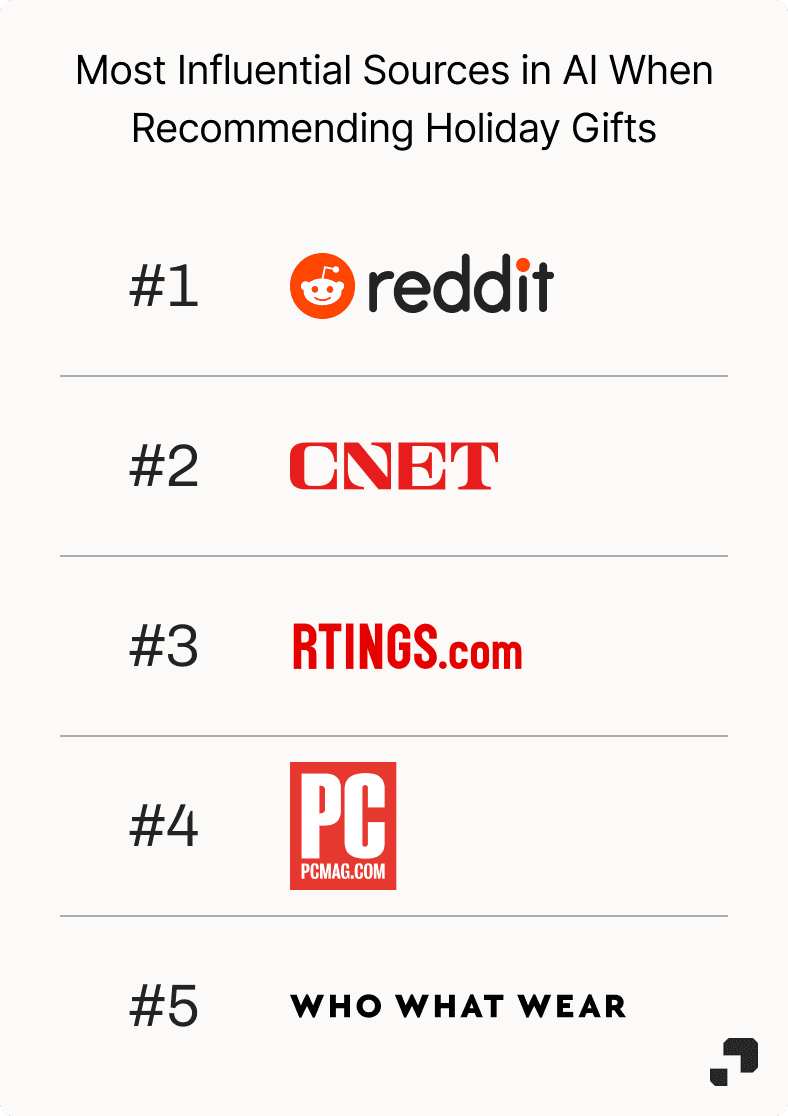
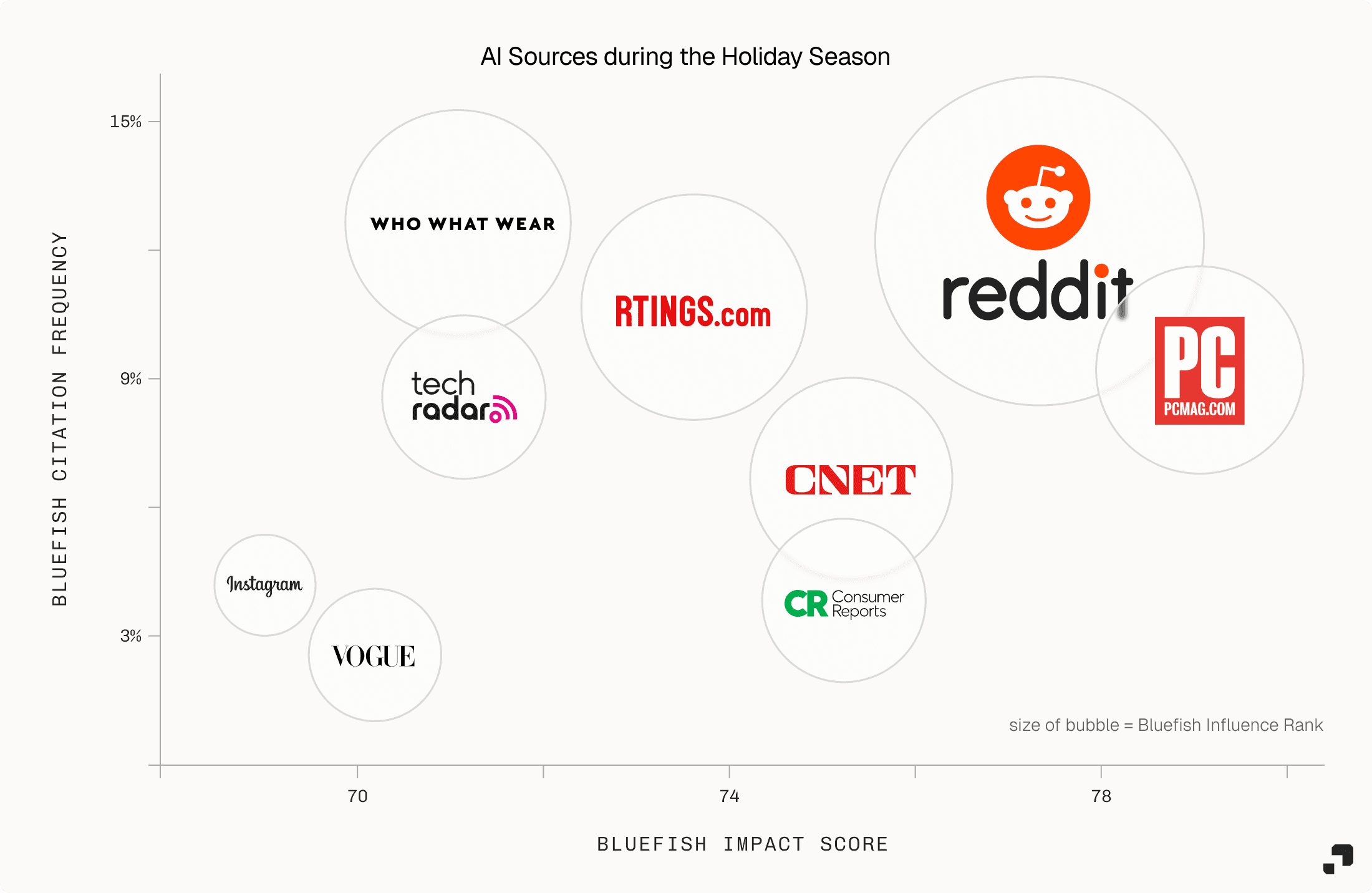
Bluefish’s Impact Score and Influence Rank metrics, originally introduced in the Black Friday report, reveal that a relatively small set of high-signal pages drove a disproportionate share of AI holiday recommendations. In multiple categories, a handful of authoritative gift guides and review roundups shaped how AI defined “best gifts” and “best deals under 100 dollars,” effectively functioning as the new upstream media placements for AI commerce.
For marketers, this changes what “coverage” means. It is no longer enough to appear in as many articles as possible; the objective is to appear in the specific articles that AI models prioritize based on consumer demographics or occasion.

From “Best Deals” to “Best Gifts”
During Black Friday, AI assistants overwhelmingly prioritized a “best deals” storyline, focusing on discounts, doorbusters, and limited-time offers. As the calendar moved deeper into December, that narrative lost momentum: Bluefish observed that “best deals” content saw its impact on AI recommendations decline by more than 30% heading into Christmas.
In its place, a more enduring “best gifts” narrative emerged and gained influence as shoppers moved from deal-chasing to thoughtful gifting. AI systems increasingly surfaced:
“Best gifts” guides by audience (for him, for her, for teens, for parents, for co-workers).
Thematic guides such as “best luxury gifts,” “best tech gifts,” and “best beauty gifts,” often anchored by a clear point of view rather than a raw discount percentage.
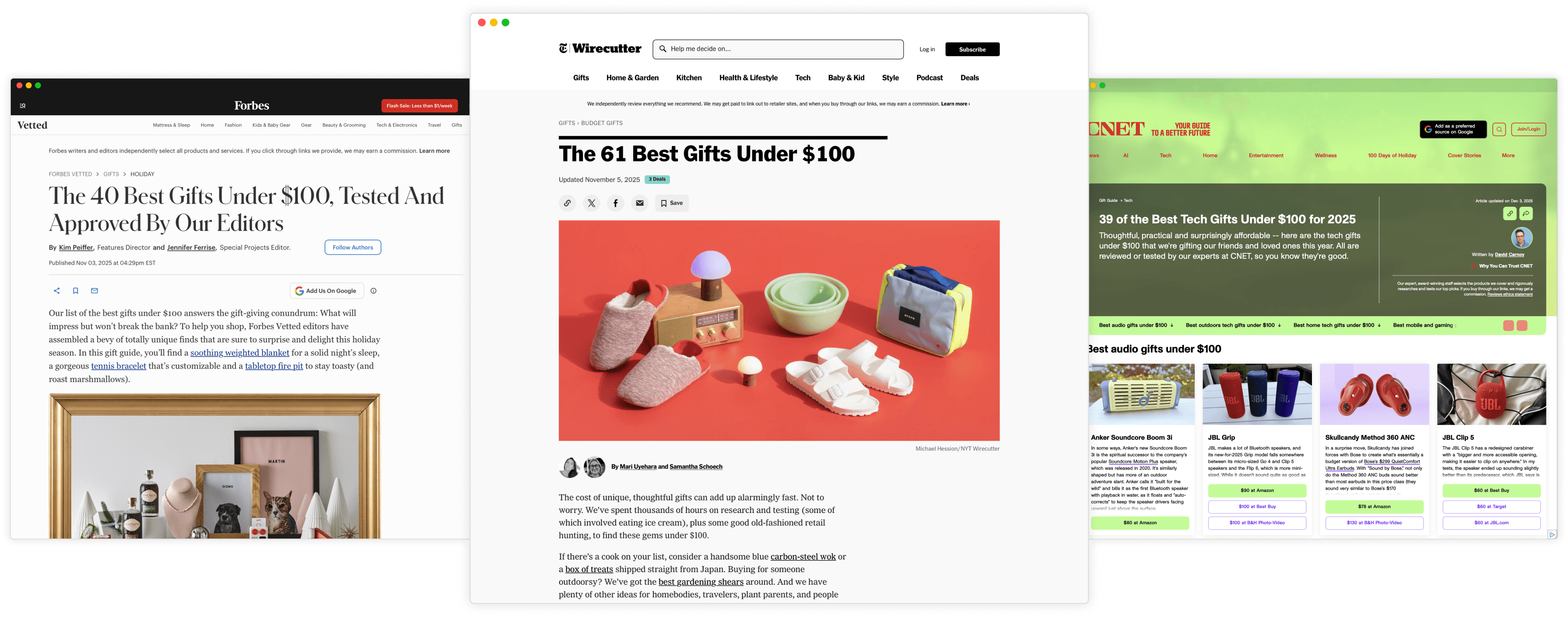
Pragmatic guides built around price thresholds, particularly “best gifts under 100 dollars,” which saw impact scores climb as the month progressed.
This transition reflects a deeper behavioral shift in AI commerce. Early in the season, shoppers use AI to exploit value: “What is the best Black Friday deal on a 65-inch TV?” Closer to Christmas, they use AI to reduce cognitive load: “What are gifts under 100 dollars for my dad who loves tech?” The brands that recognized and leaned into this pivot, from pure price to context-rich gifting, were the ones that maintained or increased visibility as Black Friday receded.
Which Brands won?
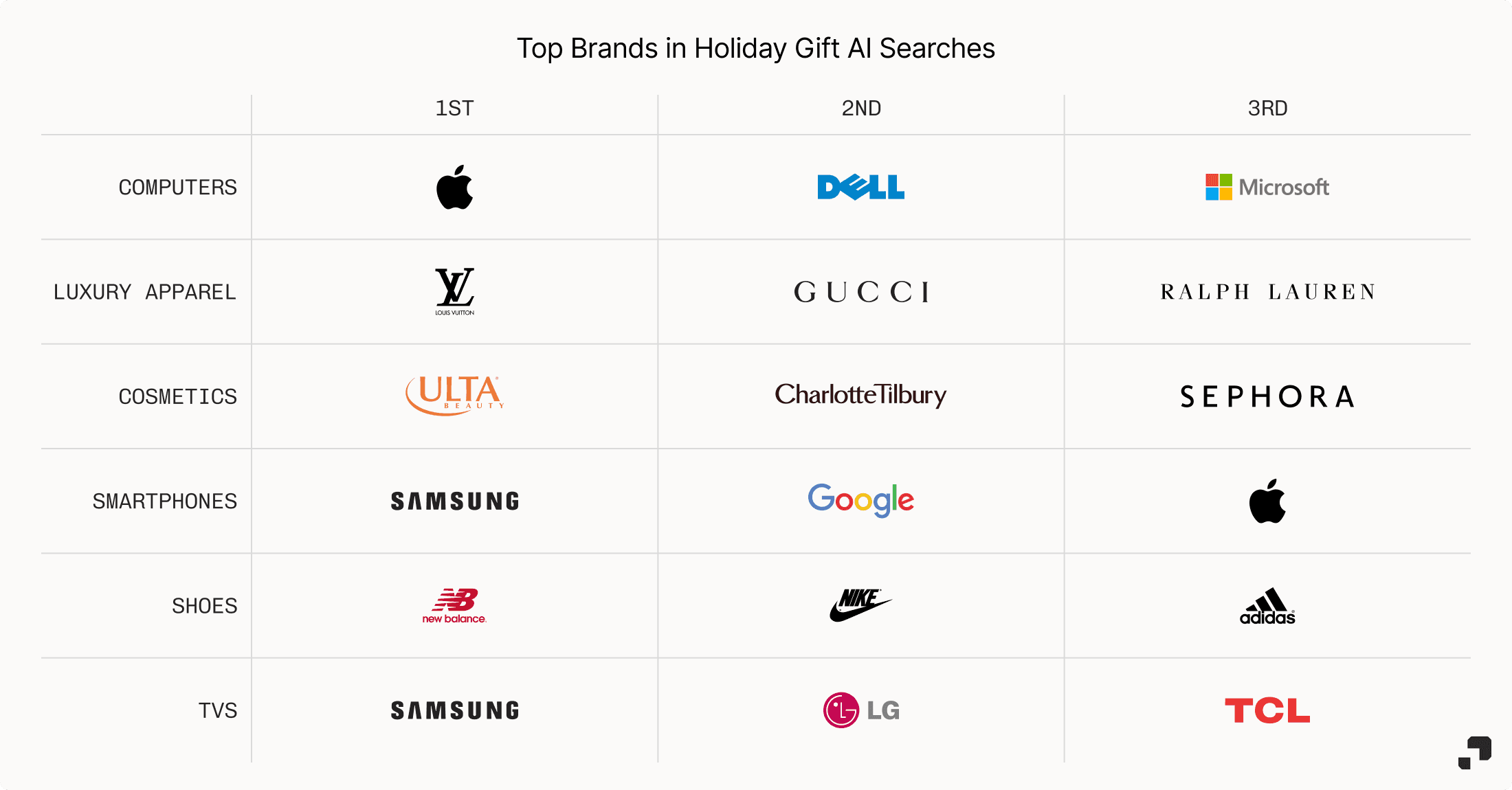
Against this backdrop, several brands emerged as clear winners in AI holiday visibility, each for different reasons but all following the same structural pattern: tight alignment between owned content, earned coverage, and the narratives AI prioritized.
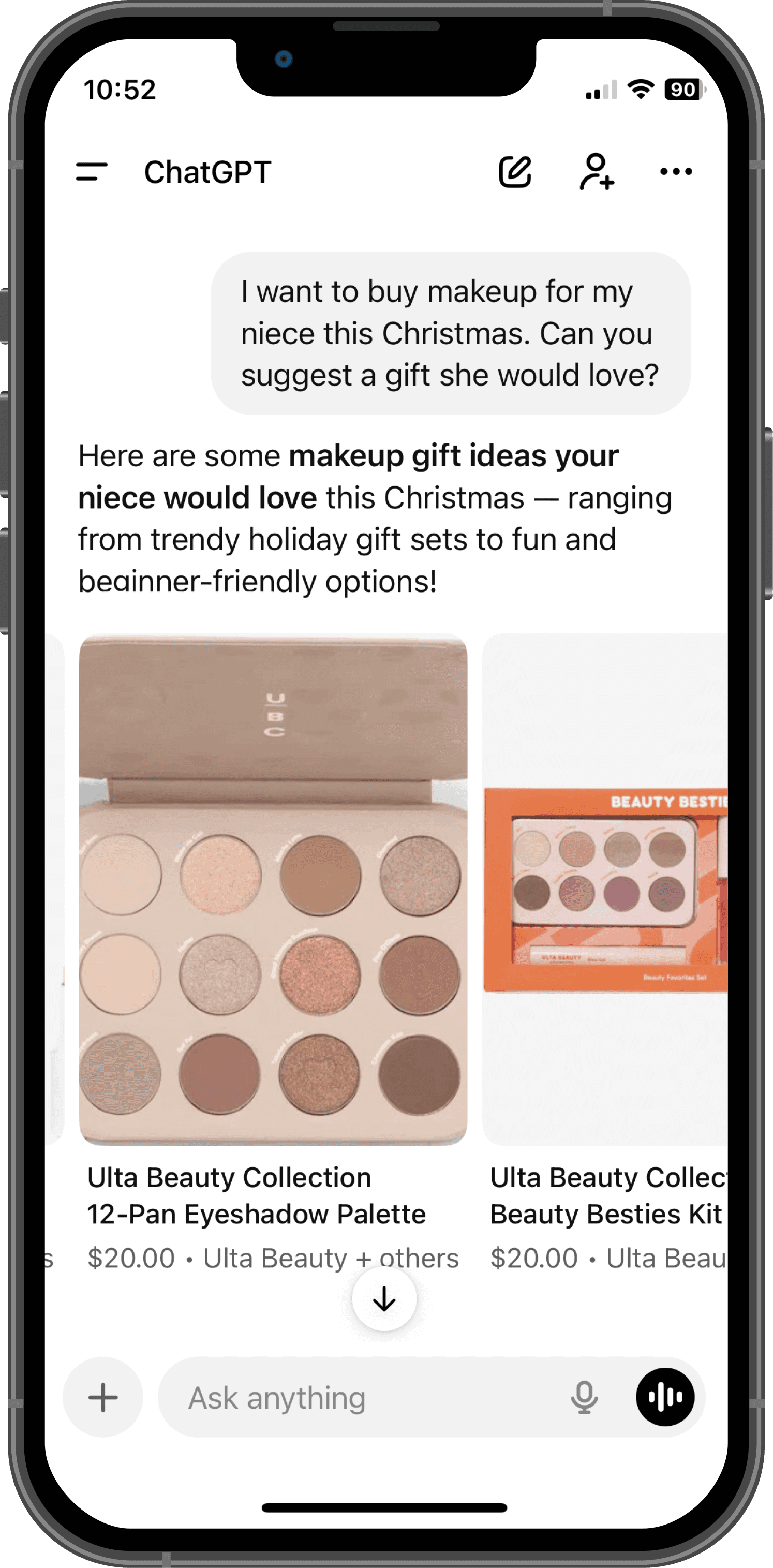
In cosmetics, Ulta distinguished itself with strong “best gift” messaging that was consistently reinforced across both owned and earned content. AI assistants frequently surfaced Ulta in gifting journeys that emphasized value, assortment, and discoverability. The brand’s success underscores how clearly labeled and well-structured gift content can convert into AI visibility even in crowded categories.
In luxury, brands such as Louis Vuitton, Gucci and Ralph Lauren achieved significant visibility as AI emphasized gifting as an expression of taste and status rather than pure savings. These brands benefited from decades of accumulated cultural relevance, but their holiday performance was also supported by a dense fabric of curated gift guides, editorial lists, and high-intent reviews that positioned them as definitive answers for “best luxury gifts.”
Across all of these segments, one pattern holds: the brands that won the 2025 holiday season in AI commerce were those that moved fastest to embrace the new paradigm, aligning content, partnerships, and measurement around how AI actually constructs answers rather than how traditional search results pages are assembled.
Wrapping up 2025 and looking ahead
The 2025 holiday season is an inflection point. Major AI platforms, marketplaces, and social platforms quietly embedded AI shopping flows in the past few months. Forward-thinking CMOs rewired holiday planning around owned and earned content, treating visibility as a core KPI measured weekly alongside ROAS.
Looking ahead to 2026, we believe that direct AI advertising will begin to formalize an even more complex reality. Early pilots suggest brands will be able to sponsor answers, secure preferred placement in AI recommendations, and test AI-native creative. Winning teams will treat this as its own performance lever, with clear targeting, creative, and measurement.
At Bluefish, we are committed to ensuring our clients can leverage AI commerce as a growth driver for their brands, especially as the landscape continues to evolve. Our platform is built to support this shifting landscape, helping brands see how AI represents them, identifying the few sources that truly drive recommendations, and systematically improving the inputs that sit between consumers and their purchase decisions.
Reach out below for your customized Holiday 2025 Brand Report.
Footnote
Paid media includes paid advertising across channels such as print, news and publishing, television, radio, direct mail, billboards, and social media. These channels are typically one-way forms of communication, where messages are delivered to audiences without direct interaction.
Owned and operated channels include the brand’s website, brand owned social media pages (not inclusive of user-generated content), retailer eCommerce sites, and Amazon product detail pages that the brands control.
Earned media includes unpaid, third-party coverage that a brand receives through editorial, journalism, or word-of-mouth rather than paid placement. This includes news articles, reviews, features, interviews, expert mentions, and “best of” lists, where the brand does not control whether or how it is covered.