" width="124.99999816468596px"><path d="M 54.181 6.847 L 47.466 6.847 L 47.466 2.585 C 47.466 2.235 47.608 1.9 47.86 1.657 L 49.06 0.496 C 49.301 0.263 49.623 0.133 49.958 0.133 L 58.443 0.133 C 58.793 0.133 59.128 0.275 59.371 0.526 L 60.532 1.727 C 60.765 1.967 60.895 2.289 60.895 2.624 L 60.895 11.11 C 60.895 11.459 60.753 11.794 60.502 12.038 L 59.301 13.199 C 59.06 13.431 58.739 13.562 58.404 13.562 L 54.181 13.562 Z M 49.016 12.012 L 42.301 12.012 L 42.301 16.235 C 42.301 16.57 42.432 16.892 42.664 17.133 L 43.825 18.333 C 44.069 18.584 44.403 18.726 44.753 18.726 L 49.016 18.726 Z M 3.126 0 L 0 0 L 0 1.966 C 0 2.122 0.061 2.272 0.169 2.384 L 0.71 2.943 C 0.823 3.06 0.979 3.126 1.142 3.126 L 3.126 3.126 Z" fill="rgb(0, 0, 0)" height="18.726460794826536px" id="Z5fIrvb9u" transform="translate(64.105 0)" width="60.8950024371469px"/><path d="M 67.271 0 L 64.144 0 L 64.144 1.966 C 64.144 2.122 64.205 2.272 64.313 2.384 L 64.854 2.943 C 64.967 3.06 65.123 3.126 65.286 3.126 L 67.271 3.126 Z M 84.707 18.726 L 84.707 0.133 L 87.841 0.133 L 87.841 7.411 C 88.558 5.87 90.019 5.127 91.799 5.127 C 93.526 5.127 94.668 5.525 95.597 6.534 C 96.607 7.623 96.686 9.058 96.686 10.705 L 96.686 18.726 L 93.499 18.726 L 93.499 10.864 C 93.499 9.642 93.446 8.898 92.782 8.261 C 92.171 7.65 91.533 7.597 90.763 7.597 C 89.621 7.597 87.868 8.181 87.868 11.342 L 87.868 18.726 Z M 76.018 19.045 C 72.911 19.045 70.228 17.69 70.122 14.503 L 73.07 14.158 C 73.096 15.884 74.292 16.787 76.045 16.787 C 77.825 16.787 78.754 16.15 78.754 15.034 C 78.754 13.866 77.107 13.653 75.115 13.148 C 72.751 12.537 70.494 11.794 70.494 9.111 C 70.494 6.269 73.07 5.127 75.726 5.127 C 78.622 5.127 81.092 6.189 81.384 9.35 L 78.489 9.828 C 78.409 8.181 77.4 7.384 75.726 7.384 C 74.557 7.384 73.468 7.836 73.468 8.872 C 73.468 9.908 74.69 10.227 76.39 10.598 C 78.887 11.156 81.729 11.714 81.729 14.848 C 81.729 18.062 78.94 19.045 76.018 19.045 Z M 56.327 18.726 L 56.327 7.969 L 54.414 7.969 L 54.414 5.445 L 56.327 5.445 L 56.327 3.586 C 56.327 1.009 57.735 0 60.444 0 C 61.081 0 61.825 0.08 62.117 0.159 L 62.064 2.709 C 61.639 2.63 61.081 2.577 60.789 2.577 C 59.886 2.577 59.461 2.736 59.461 3.612 L 59.461 5.445 L 62.171 5.445 L 62.171 7.969 L 59.461 7.969 L 59.461 18.726 Z M 64.11 18.726 L 64.11 5.445 L 67.27 5.445 L 67.27 18.726 Z M 46.183 19.045 C 44.111 19.045 42.517 18.381 41.375 17.212 C 40.153 15.964 39.595 14.211 39.595 12.059 C 39.595 10.014 40.18 8.261 41.375 6.986 C 42.544 5.764 44.137 5.127 46.156 5.127 C 48.255 5.127 50.034 5.923 51.15 7.331 C 52.212 8.659 52.744 10.678 52.664 12.962 L 42.783 12.962 C 42.836 15.433 43.951 16.681 46.156 16.681 C 48.095 16.681 49.105 15.858 49.397 14.237 L 52.451 14.476 C 51.761 17.531 49.583 19.045 46.183 19.045 Z M 42.809 10.598 L 49.45 10.598 C 49.397 9.855 49.158 9.084 48.706 8.527 C 48.122 7.809 47.325 7.491 46.156 7.491 C 44.908 7.491 44.005 7.916 43.473 8.659 C 43.048 9.244 42.862 9.961 42.809 10.598 Z M 29.597 19.045 C 27.897 19.045 26.728 18.594 25.772 17.584 C 24.736 16.495 24.63 14.848 24.63 13.228 L 24.63 5.445 L 27.844 5.445 L 27.844 13.069 C 27.844 14.29 27.87 15.22 28.508 15.884 C 29.145 16.522 29.836 16.575 30.606 16.575 C 31.855 16.575 33.475 15.937 33.475 12.776 L 33.475 5.445 L 36.583 5.445 L 36.583 18.726 L 33.502 18.726 L 33.502 16.787 C 32.785 18.248 31.43 19.045 29.597 19.045 Z M 17.85 18.726 L 17.85 0.133 L 21.011 0.133 L 21.011 18.726 L 17.85 18.726 Z M 0 18.726 L 0 0.133 L 6.773 0.133 C 10.227 0.133 14.052 0.664 14.052 5.18 C 14.052 7.092 13.069 8.447 11.555 9.191 C 13.6 9.934 14.769 11.289 14.769 13.573 C 14.769 18.222 10.97 18.726 7.066 18.726 Z M 3.32 16.07 L 6.959 16.07 C 9.536 16.07 11.528 15.99 11.528 13.414 C 11.528 10.625 9.111 10.572 7.092 10.572 L 3.32 10.572 Z M 3.32 7.916 L 6.561 7.916 C 8.792 7.916 10.811 7.862 10.811 5.366 C 10.811 2.895 8.792 2.816 6.588 2.816 L 3.32 2.816 Z" fill="rgb(0, 0, 0)" height="19.04499996813226px" id="hc3K9vveG" width="96.68634569718273px"/></g></svg>)
Bluefish Proves Super Bowl Ads Influence AI Recommendations

Bluefish Research
Table of contents
Share

The Super Bowl continues to be one of the few remaining mass-audience opportunities, commanding an average of $8M per 30-second spot. And yet, the Super Bowl audience of 125 million people is just an ordinary week for AI channels.
As viewership migrates to streaming platforms and consumer attention shifts to AI channels, CMOs face mounting pressure to justify traditional media investments. Beyond raw reach, it’s difficult to quantify the full business impact of Super Bowl advertising.
Bluefish has introduced a groundbreaking new way to measure Super Bowl ad ROI: measuring the impact of a brand's advertisement based on how major LLMs portray these brands to millions of consumers.
Bluefish analyzed 52 brands that advertised during Super Bowl LX, measuring their performance across AI channels. The findings show Super Bowl ads drive measurable increases in AI visibility (how often a brand appears in AI responses) and AI favorability (how positively a brand is portrayed in AI responses).
As consumers increasingly use AI to discover brands and buy products, these metrics determine which brands are recommended and which are left out of the answer. In this report, Bluefish leverages proprietary data to reveal how the 2026 Super Bowl Ad lineup influenced performance across AI platforms.
Brands with the highest AI visibility and highest AI favorability after advertising in the 2026 Super Bowl
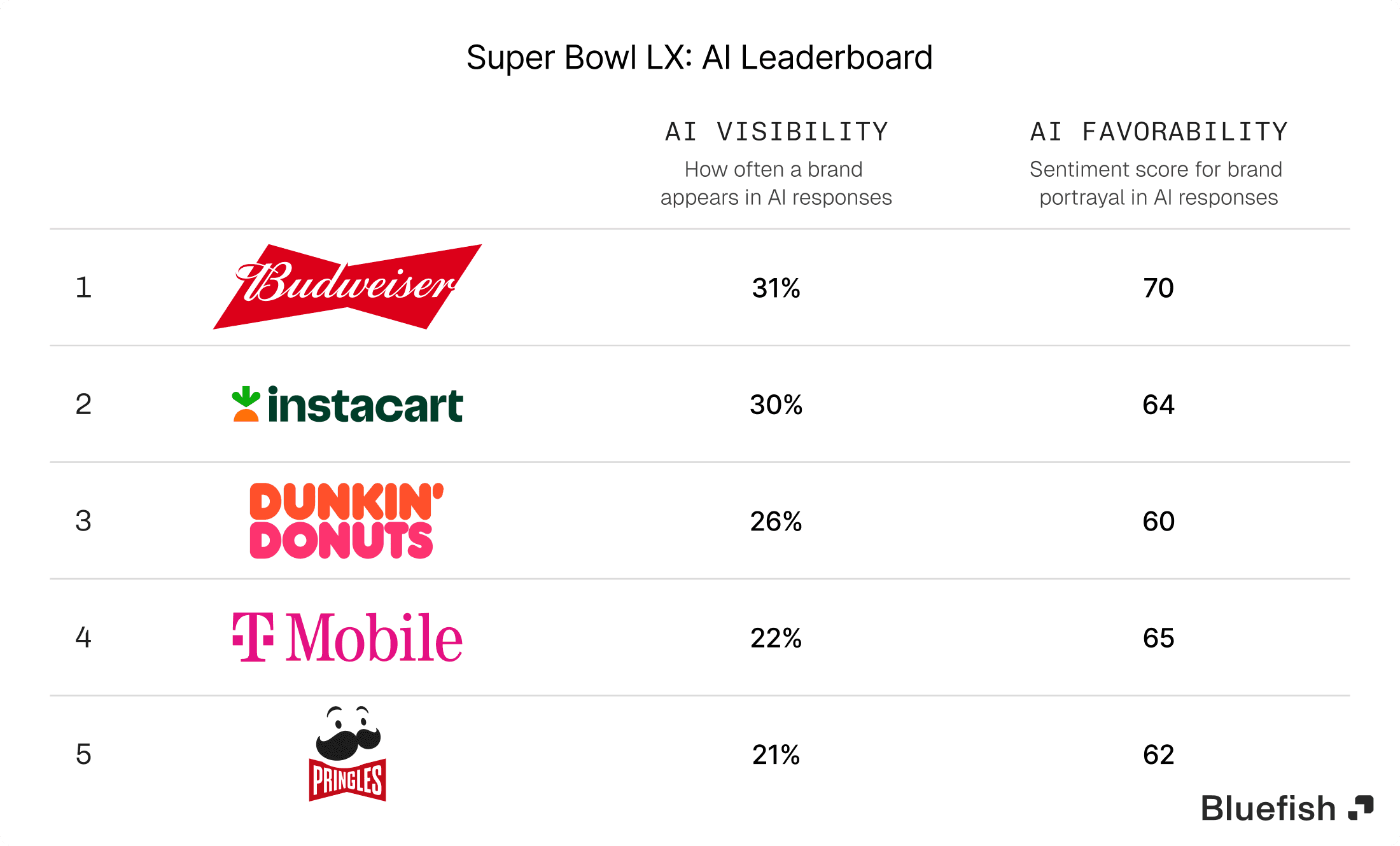
Budweiser’s Super Bowl ad won AI
Budweiser topped USA Today’s Ad Meter and also achieved the highest visibility and favorability scores across AI channels. This insight emphasizes the role of earned media as one of many sources that Large Language Models (LLMs) consider when forming responses.
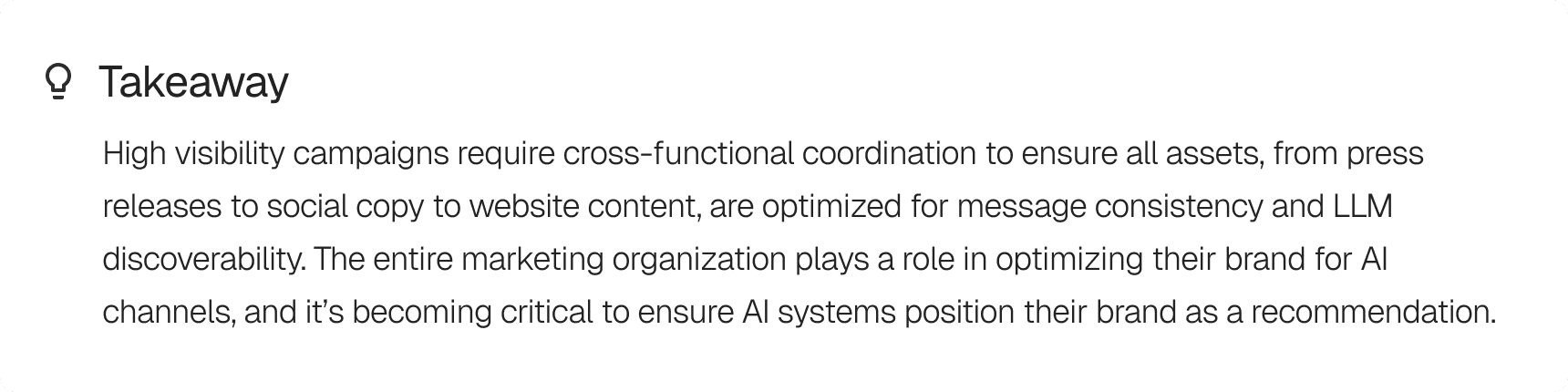
In addition to earned media coverage, LLMs synthesize social media, owned website content and third-party content to formulate answers, prioritizing brands with consistent messaging across all touch points. For Super Bowl campaigns, this means the brands on the AI Leaderboard weren’t just the most talked about, they told the most consistent story everywhere they showed up. To ensure consistency, AI performance requires investment across the entire organization, not just search or GEO-focused teams.
This translates into competitive advantage: brands with higher AI visibility and favorability scores earn preferred positioning in AI-powered shopping experiences. As consumers increasingly rely on AI to discover and purchase products, AI channel performance becomes a driver of conversion and revenue. This suggests AI Marketing could finally connect Super Bowl investments to bottom line ROI for AI purchases.
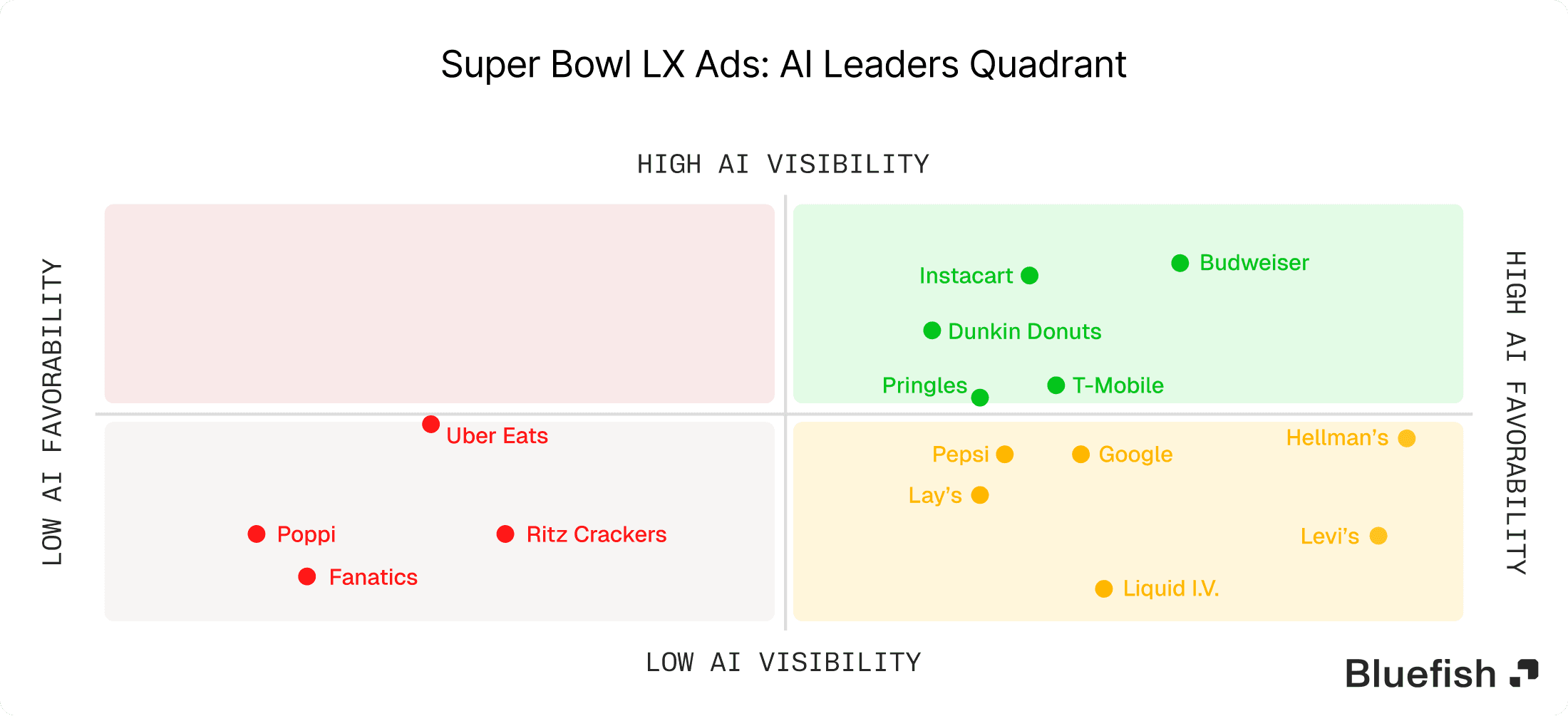
The brand leaders in the upper right quadrant achieved both the highest AI visibility and highest AI favorability scores among all 52 brands that were analyzed
2. Super Bowl ads deliver meaningful AI favorability gains
While brands increasingly premiere commercials before kickoff to maximize earned media, Bluefish found that release timing had no impact on AI favorability performance. Interestingly, the three brands with the highest favorability scores (Homes.com, Hellman’s and Levi’s) all premiered during the broadcast.
While release timing wasn’t a factor, the Super Bowl investment itself delivered measurable favorability gains in AI. Bluefish analysis reveals Hellmann’s saw a 27% increase in AI favorability, Michelob Ultra jumped 35% and Novartis rose by 38%.
Bluefish found Hellmann's, Michelob Ultra and Novartis saw the biggest lift in AI Favorability as a result of running ads in the Super Bowl
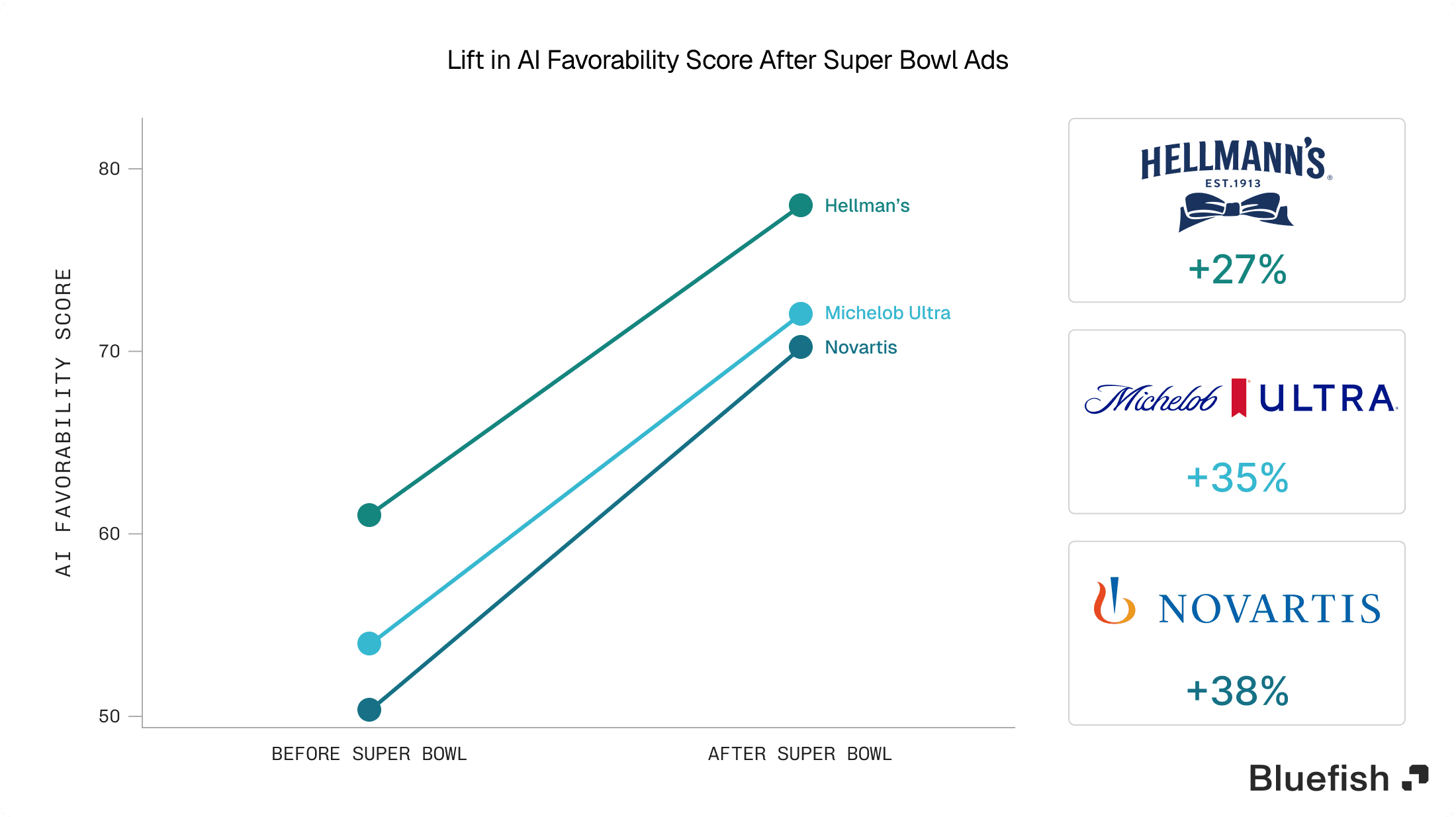
These favorability increases represent the importance of brand positioning within AI channels, as AI performance increasingly drives product discovery and consideration at the point of digital purchase intent. For instance, when consumers ask AI to compare beer brands, these favorability gains directly influence whether a product is recommended or not in LLMs.
AI rewards human creativity
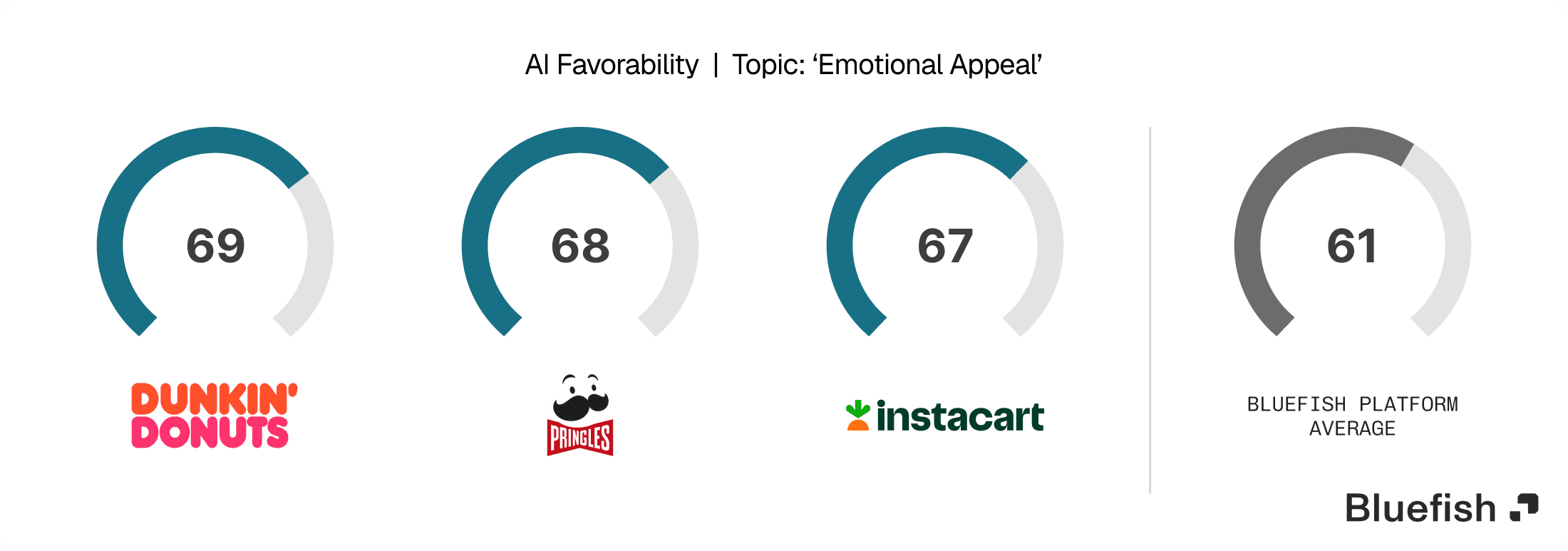
Bluefish found that authenticity and relatability were the most important topics that LLMs considered when evaluating Super Bowl ads. Three of the top five most visible brands (Dunkin’ Donuts, Pringle and Instacart) scored above the industry average (61) in favorability for emotional appeal, with scores of 69, 68, and 67 respectively. All three ads leaned on humor and celebrity, which played a role in the “emotional appeal” scoring.
Three of the most visible ads in AI scored above the industry average (61) in favorability within the "emotional appeal" topic on Bluefish
Bluefish Narrative Trend analysis revealed that AI channels consistently cited sources praising human authenticity and emotional resonance, while dismissing AI-generated creative as “stale and uninspired.” Brands criticized for formulaic executions saw favorability scores decline by as much as 53%.
This finding proves creative quality directly impacts business outcomes. Favorability determines whether AI channels cite brands positively when consumers are making purchase decisions. For brands that invested millions in Super Bowl spots, Bluefish’s analysis finally quantifies the ROI of investing in creative versus cutting corners with generic content.
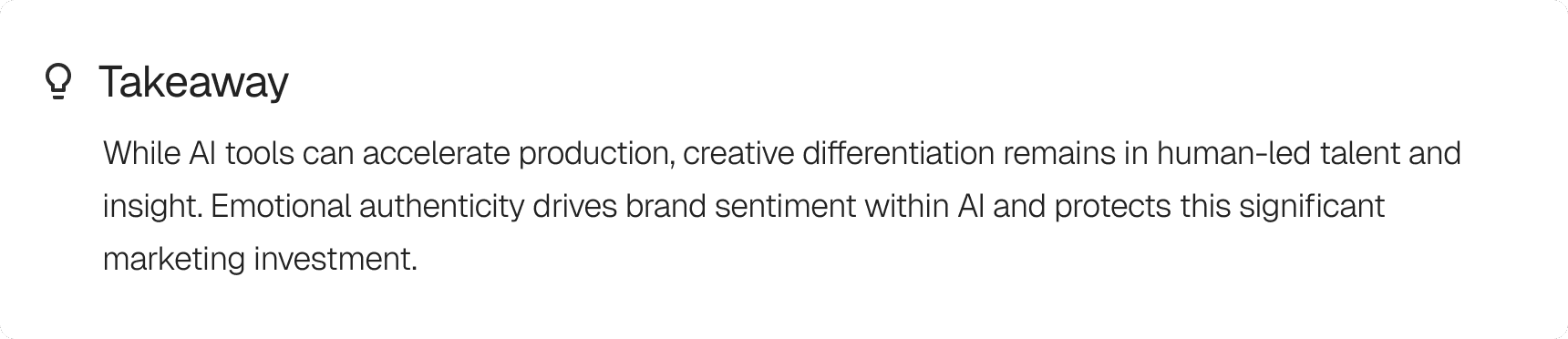
The campaigns that resonated most with both people and AI channels demonstrated distinctive human creativity. Generative AI simply cannot replicate wit, cultural insight and emotional intelligence at scale.
The Bottom Line: Traditional investment can translate into measurable AI returns
The 2026 Super Bowl demonstrates that traditional advertising investments can deliver ROI in AI channels. The brands that won didn't just buy airtime, they developed emotionally resonant campaigns that were consistent across every touchpoint.
Competitive advantage belongs to marketing teams that approach AI Marketing as a team sport — collectively driving performance cross-functionally, while maintaining consistency of message. AI Marketing can’t be siloed to search teams as a simple GEO strategy when its impact has broader implications for the entire organization.
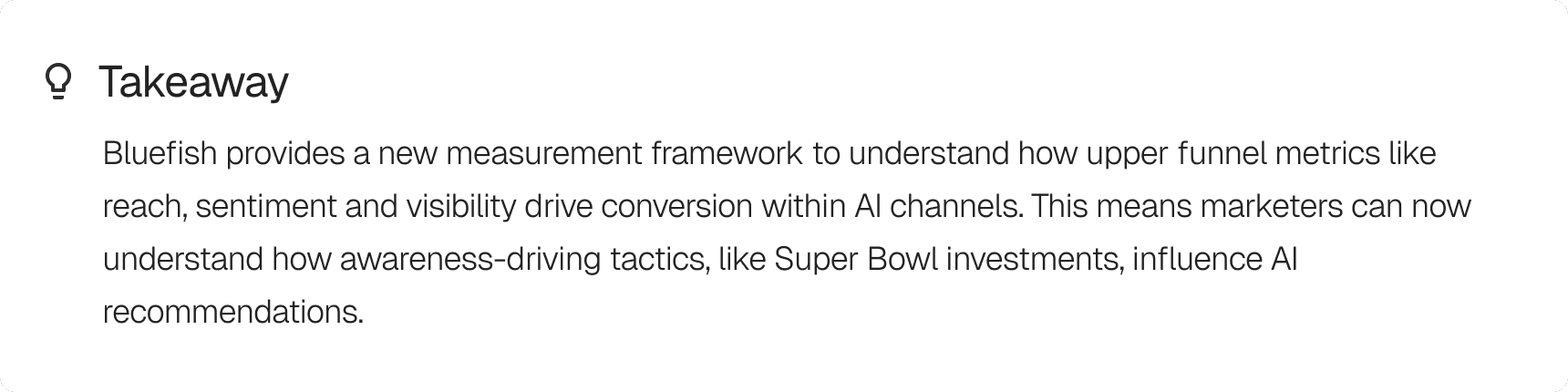
As AI reshapes the path to purchase, AI marketing enables CMOs to better understand how awareness-driving tactics connect to performance in AI channels. Proving how a Super Bowl investment influenced AI visibility and AI favorability is critical because these metrics determine whether brands get recommended in an environment that is increasingly driving conversions.
Ready to optimize your brand's AI performance? Contact Bluefish to learn how our platform can optimize your visibility and favorability across AI channels and turn proprietary insights into revenue-driving performance.
Speak with one of our AI Marketing experts
Connect with an AI Marketing specialist to learn more about how Bluefish can elevate your brand's presence and performance across AI channels